FAQs
Some questions that we and other rescue centres frequently get asked are answered here.
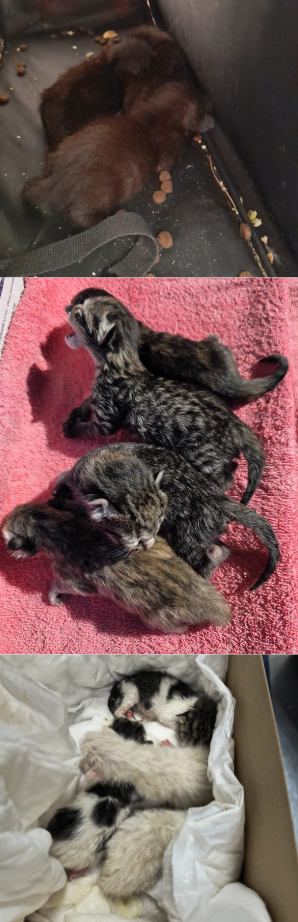
What Should I Do If I Find Kittens Alone On The Street (Especially Newborns)?
Ask basic questions about their location.
If they are inside of a bin or bag or somewhere that their mother did not likely give birth, they were probably put there by humans.
If they are out in the open, inside a building, or anywhere a cat can get in and out of, it's most likely that their mother is still around.
Stay observant but out of the way so that the mother can feel safe to come back for them, only capable of taking one at a time.
It is important to NOT touch them until you are sure they've been rejected. If you get your scent on them, the mother is more likely to reject them.
How can you tell if they've been rejected?
The mother can take up to 24 hours (sometimes even 48) to collect all of her babies and move them to somewhere safer.
It is important to observe from afar so that the mother doesn't become afraid of returning.
If you become sure after this time period that they have been rejected, they need to be kept warm, fed, and safe.
How Can I Care For Them?
Many people who find kittens give them milk from the store. Cows milk. Cows are herbivores, which means that their milk contains different nutrients to what a carnivore like a kitten needs to survive. It is important to buy kitten milk from the vet for them.
Heated blankets, thermal lamps, and other sources of heat can be used to maintain a warm body temperature until they can regulate their own body heat.
If you have any doubts or find yourself in this situation, please contact us.
If you find them in a bin or bag or other setting that only a human could've put them in, contact us straight away.
If you have followed through on the other steps and found that they have been rejected, contact us.
We are here to help these cats, and we are equipped to care for them.

What Should I Do If I Find An Injured Or Visibly Ill Street Cat?
If you find an injured or visibly ill street cat, it is important to contact a local vet and/or rescue centre. It is important to have their situation evaluated for the best course of treatment and to know what is wrong. Some may require immediate hospitalisation while others may simply need somewhere safe to rest and recover.
In Spain, the Ayuntamiento is legally responsible for the urgent care of injured and seriously ill street cats. If the cat has a non-urgent illness (such as conjunctivitis or a cold), the Ayuntamiento is not responsible for treatment.
What Classes As Urgent?
If the cat can not or struggles to walk, is disoriented, is bleeding, can't move, or you have seen it experience a trauma (such as being hit by a car or attacked by a human or another animal), these are all serious issues that require medical attention.
What Is The Difference Between A Stray Cat And A Feral Cat?
It can be hard to differentiate these two types of street cats. Feral cats and stray cats usually cohabit the same areas, share food, and even form parts of the same colonies together. It is important to know that despite this, they are not the same.
Stray Cat
Stray cats are most commonly cats that were once owned and are usually friendly with people. Many stray cats were abandoned on the streets. Some may have gotten out of their homes and ran away or gotten lost.
Can They Be Tamed?
In most cases, these cats can be rehomed safely.


Feral Cat
Feral cats were typically born on the streets. They are usually unfriendly with humans or avoidant of humans. Some can become accustomed to their colony caretakers but will always be wary of strangers. It is important to not mistake an accustomed attitude for a friendly attitude.
Can They Be Tamed?
Feral cats can not be homed. The fear and stress of being forced into a home can cause serious health issues and even result in their death. They can also attack the humans in a mix of fear and desperation to escape.

What Is TNR?
TNR stand for Trap, Neuter, and Release. It is a programme intended for the benefit and welfare and health of street cats. It is also used to reduce the number of cats on the street humanely by simply ensuring that street cats do not get pregnant and give birth to more cats that would be condemned to a life of survival on the streets.
The TNR programme is paid for by the Ayuntamiento and carried out by the colony caretakers and veterinary clinics in the area.
(Note: not all vets collaborate with the Ayuntamiento for this programme. In some towns, only one clinic has an established agreement with the Ayuntamiento to do the sterilisations of street cats)
Why Do Street Cats Get "Ear-Tipped"?
Ear-tipping is something that the vet does by leaving a cut in a cats ear to identify it as an already sterilised street cat. The most common cuts are the very tip of the ear removed or a triangular or U-shaped cut in the outer side of the ear. These indicators show vets and colony caretakers that a cat has already been sterilised and does not need to be caught again for TNR.